













Weston College has a wide range of courses to suit all learning styles
Weston College is an award-winning college of further and higher education in Weston-super-Mare. It provides education and vocational training to nearly 30,000 learners across the country.
We put the learner first and are entrepreneurial in our approach and innovative in our thinking. As a college, we are ambitious and aspirational and are responsive to the needs of students, staff, businesses, and the community.
Latest News
There is always so much going on across our various campuses and courses. Stay up to date on our latest news.
For prospective university students and their parents, the costs and loans associated with university can be daunting and confusing. Many news articles obscure this further by presenting misleading information.
An article on FE News recently analysed research from the bank ‘B’. The article refers to a series of statistics which creates the overall impression that students are in the dark with regard to student finance which is causing a series of issues.
- Students will not earn enough to repay their debt
- A quarter of students believe they will be bankrupt before they turn 30
- 38% of students don’t know how much they will owe
- 75% don’t know how much they will repay
- 52% don’t know when they will make repayments
- 80% don’t have a plan to manage their finances
The majority of these statistics and theories feed into the idea that all students going to university are going to be saddled with mountains of debt and that they will be faced with eye-watering and financially damaging repayments.
In reality the student finance system is far more supportive and the repayment mechanisms in place recover a proportion of the debt in a way which is financially sustainable for the graduate.
The idea that many students will not repay their debts might well be correct, but perhaps not to the extent that you would expect.
The Financial Times found that “About 70 percent of students who left university last year are expected never to finish repaying their loans, according to modelling carried out by the Institute for Fiscal Studies. Instead they will have to make repayments for 30 years before then having the unpaid loan written off".
The current system of student finance has a time limit on the repayments, this does not mean that 100% of the loan has to be repaid before the end of the term, but rather than any remaining debt on the account at that point is cleared in full.
At present, this term is set at 30 years from the April after the student graduates from university, therefore the misconception that students will be saddled with this debt for life is incorrect and it is unlikely that the majority of graduates will repay the loan in full.
The claim that a third of students believe that they will be bankrupt by the age of 30 stems from a deep seeded misunderstanding with how the student finance system works. To explore why this will, most likely, not be the case it is necessary to look at the amounts students will owe and how and when will graduates make their repayments.
In the present system the most a university can charge for tuition fees is £9,250 (a total of £27,750 over three years). In addition to this fee, students are able to apply for a means-tested maintenance loan, which if moving away from the parental home and not studying in London could add an extra £8,700 per year, or £26,100 over three years, to the total figure owed by students. The total amount which could be owed by a learner is £53,850 (based on 2018 figures with student moving away from home and not to London).
In addition to the total loan amount, there is interest from the day the first payment is made at a rate of the Retail Price Index (RPI) plus 3%. At present RPI is set at 3.1% and is a variable rate which is taken every March for the following year’s calculations. Therefore the amount that graduates owe is set to rise each month.
Graduating students do have the potential to owe over £50,000 in student loan debt when they graduate, this is undeniably a huge amount of money and if it were a regular loan would likely see the monthly repayments of up to £400 over a 25 year period.
This is where a comparison with a standard loan ends as student debt needs to be considered as something entirely different, this is what is often difficult for students and their parents/carers to understand. The mechanisms for repaying the student debt does not differ based on the amount borrowed, the terms of repayment are the same for all graduates.
Graduates will start to repay their loan as of the April after they graduate from university, or when they leave their course. Repayments will only begin once the graduate is earning above the threshold which is currently set at £25,000. Therefore any graduate who does not earn above this threshold will not make any repayments on their student debt.
Once a graduate is earning above the threshold they will make repayments on any amount over this threshold, which will be taken directly from their pay at a rate of 9% (for example if the graduate earns £26,000 they will repay 9% of £1,000 which would amount to repaying £90 in that tax year).
This mechanism for repayment is there to ensure that graduates are able to make affordable repayments on their student loan and graduates will not have to manage this debt as it is taken through their pay packets.
Therefore in comparison with a standard debt, which might see an annual repayment of £4,800 per year on a £50,000 loan, the student loan repayments are far more sustainable at 9% of earnings over £25,000 and the remaining debt at the end of the 30 year term is written off entirely.
In reality, the notion that almost a quarter of students believe that they will be declared bankrupt by the time they are 30 is likely a misconception based on misunderstanding the student finance system and the schedule of repayments.
Better representation and information in the media would act to provide a widespread education on student finance to alleviate students who feel anxious about repaying the money they are borrowing for higher education.
Many of the misconceptions about student finance are rooted in a lack of understanding of how student finance works and more positive actions by the media need to be taken to create some widespread change in the way that people regard student debt. It may be that extensive PR needs to take place or a ‘rebranding’ of what it is called to get away from the negative connotations with the word ‘debt’.
Students, and their parents/carers, need to be made aware of the positive aspects of the student finance system and they need to be completely aware of how much they will owe, how and when they will make the repayments and how long the term of the debt is. If this information is successfully communicated in the media then it may act to alleviate the anxiety felt by students so that they can understand that yes they have student debt, but that it will most likely not bankrupt them as their weekly/monthly repayments are always proportionate to their earnings and not to the amount they owe.
Hamish Gilpin, UCAS Lead, Weston College

Students at Weston College will be among the first in the country to study the new T Level qualification.
The College is one of just 54 providers selected to launch the new technical equivalent to A Levels.
T Levels will be available in 15 industry-related subjects, known as ‘pathways’. Weston College will deliver the Digital (software applications design and development) programme from September 2020 – two years before the full roll-out.
Dr Paul Phillips CBE, Principal and Chief Executive of Weston College Group, said: “T Levels have been described as the biggest overhaul in post-school education for 70 years.
“For Weston College to be at the forefront of this revolution is an honour and an exciting challenge. We’ve built a national reputation for the quality of our sixth form and helping to launch this pioneering programme only enhances that standing.
“It also represents a tremendous opportunity for school leavers in Weston-super-Mare and beyond.
“T levels are shaped by employers and benefit from the unique insights of industry leaders. This means learners will be equipped with the skills and knowledge they need to get ahead in the modern jobs market.”
Delivered over a two-year period, T Levels provide an alternative to A Levels and are aimed at 16 to 19-year-olds who would rather study work-related courses than traditional academic subjects. They have been launched to counter the long-held assumption that only A Levels and a degree can lead to a fulfilling job. Though, T Level students will still be able to progress to university or higher-level technical qualifications.
T Levels have been created by expert panels of employers, are also designed to deliver the necessary skills required to strengthen and grow the UK economy. They will provide a mix of industry-specific technical knowledge and practical skills; relevant maths, English and digital skills; and a work placement of at least 45 days.

Further education (FE) colleges are an essential cog in the education ‘machine’ in England.
As Principal of a college, you might say I’m biased.
But I’d argue that’s given me extensive, first-hand experience of how colleges help people of all ages and backgrounds make the most of their talents and ambitions. And these are only the direct benefits. If you consider the role colleges play and the influence they have in the wider communities, it’s clear they are in driving social mobility and boosting local and regional economies.
And these are only the direct benefits. If you take into account the role colleges play and the influence they have in the wider communities, it’s clear they are driving social mobility and boosting local and regional economies.
To put it bluntly, colleges matter – to their students, staff and local communities.
However, it’s no exaggeration to say their futures are in jeopardy due to the extensive and continued funding cuts affecting the sector.
For too long the vital work of colleges has been overlooked and underfunded.
The total college income in England has fallen by £1 billion since the start of the decade, which represents a funding cut of around 30%.
This drop in funding has led to:
- Fewer hours of teaching and support for young people
- Course closures
- A reduction in the number of learning opportunities for adults
- The value of staff pay falling by over 25% since 2009
- Job losses and recruitment problems
- College teachers earning £7,000 less on average than school teachers.
The situation is completely unsustainable and we need action now.
Fortunately that action is materialising in the form of the ‘Love our Colleges’ campaign, led by the Association of Colleges who are uniting the sector in pursuit of one overarching goal – appropriate funding of further education.
This includes:
- Increasing the 16-19 funding rate by 5% a year for the next five years, and extending the pupil premium to cover post-16 students
- Fully funding a National Retraining Scheme to support Level 3 to 5 skills
- Introducing a lifetime learning entitlement to fund skills training for all adults who have not previously achieved a level 3 qualification.
As well as making the case for extra government funding and fair pay in FE, ‘Love our Colleges’ is also highlighting the great work that goes on in colleges, and the brilliant staff that make it all possible.
The campaign is supported by UCU, Unison, Unite, GMB, NEU, NUS, TUC, ASCL and the Association of Colleges, who organise and co-ordinate a string of events and activities throughout the year.
But among the many great aspects of ‘Love our Colleges’ is that individual colleges and students can get involved to keep the issue at the top of the government’s agenda.
For instance, you can support the campaign by tweeting using the #LoveOurColleges hashtag to say why you think the government should invest more in colleges and their staff and students; and write to your local MP asking them to support fair funding in FE and sign Early Day Motion 1686 calling for urgent investment in FE colleges.
To find out more about Love our Colleges and its various events, take a look here.

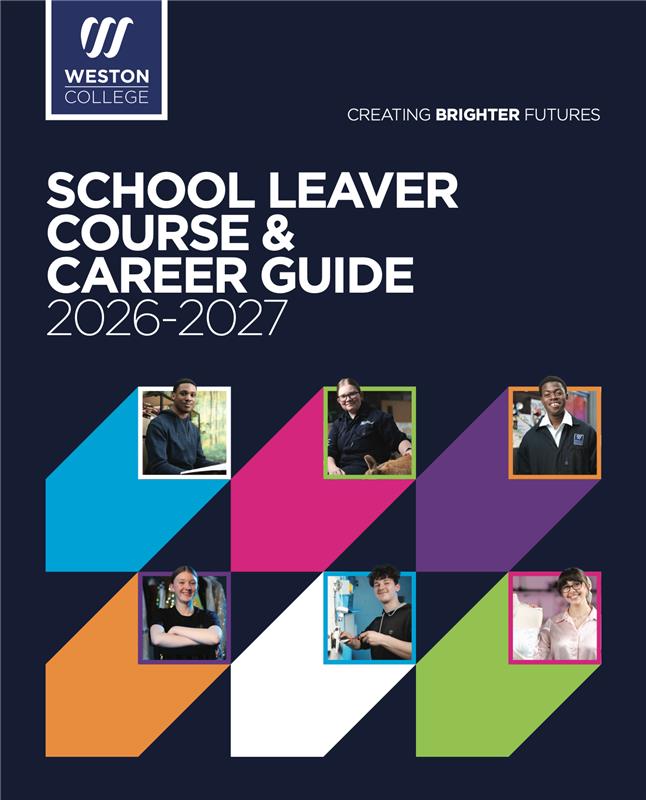
CAREERS NOT COURSES
We know it’s not about the course you take, but the career you’ll start your journey towards. Your study programme is built from the ground up with your future in mind, focussing on employability and developing the skills you need to have a successful career within your chosen industry, making connections and gaining experiences through local and national employers we work with:





















As a Weston College student, you will become part of one of our exciting new Career Excellence Hubs.
This means our courses aren't just courses... your study programme is built from the ground up with your future in mind, focussing on employability and developing the skills you need to have a successful career within your chosen industry...
LECTURERS WITH REAL INDUSTRY EXPERIENCES
COURSES ENDORSED BY EMPLOYERS
INDUSTRY STANDARD FACILITIES
INCREDIBLE WORK-BASED OPPORTUNITIES
AMAZING GUEST LECTURES
COURSES ENDORSED BY EMPLOYERS

VIEW OUR PROSPECTUS


"The college organised lots of amazing experiences for us with specialist guest lectures on sepsis, home care, nutrition and bee therapy"
Chloe
Health and Social Care, Level 2 & 3
