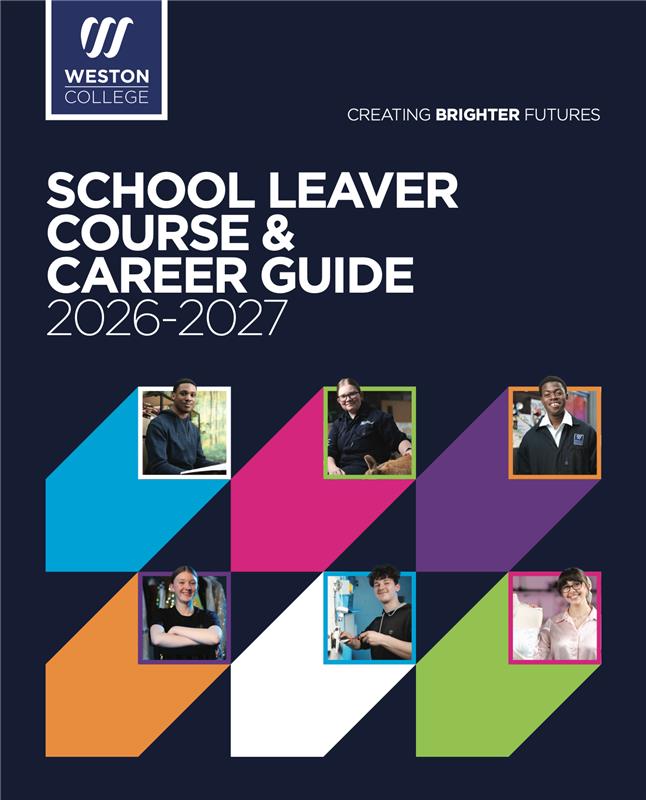















Looking for the perfect course? Find courses
 
blue background
blue backgroound
thermometer showing 35 degrees plus

IMPORTANT INFORMATION FOR LEARNERS

HOT WEATHER ARRANGEMENTS

blue background
blue backgroound
a seagull in front of a cartoon sun with an ice cream

SUMMER SPECTACULAR

CELEBRATE THE END OF
THE ACADEMIC YEAR IN STYLE

blue background
blue backgroound
girl standing in front of a camera

SUMMER SHOWCASE

JOIN US FOR OUR END-OF-YEAR
CREATIVE ARTS EXHIBITION

blue background
Mobile blue background
Two students from Weston College, representing academic and vocational training.

OPEN EVENTS

DISCOVER OUR NEXT EVENT

blue background
blue background
a first bus

GETTING TO COLLEGE

SEE GUIDANCE ON GETTING
YOUR TRAVEL TICKETS

blue background
blue backgroound
2 graduated female students in their gowns

DEGREES AT WESTON

APPLY NOW AT UNIVERSITY
CENTRE WESTON

Previous
Next

We are Weston College 

We are Creating
Brighter Futures.

Read More

Weston College has a wide range of courses to suit all learning styles 

Weston College is an award-winning college of further and higher education in Weston-super-Mare. It provides education and vocational training to nearly 30,000 learners across the country.

We put the learner first and are entrepreneurial in our approach and innovative in our thinking. As a college, we are ambitious and aspirational and are responsive to the needs of students, staff, businesses, and the community.

Latest News

There is always so much going on across our various campuses and courses. Stay up to date on our latest news.

Personal Statement Basics

The personal statement is the most important part of your application. If you are applying for a course that does not require an interview, the admissions team will be making a decision mostly based on your statement. If you are applying for a course that does have an interview, then the admissions team will decide whether to put you through to interview based on the statement, so either way it is really important. But don’t see it as a threat – it’s a great chance for you to let the university know why you are so motivated to study that subject and how you have developed that interest.

The maximum length is 4000 characters including spaces, which is around 500-700 words depending on how long your words are. Make sure you aren’t over the character count as UCAS will cut you off once it reaches 4000. If you’re struggling to keep within the character count, ask ASPECT to take a look and try and cut it down for you. It should be in paragraphs and have a clear introduction and conclusion; it should be written as an essay rather than a letter. 75% of your statement should be about your motivation to study the subject and how you have developed this interest and your relevant skills through college and work experience, and then 25% is about your extra activities.

What goes in the personal statement?

Make sure you keep your statement content really relevant to the subject you are applying for. You should write about your current course and any other courses you have done that are relevant, and mention your work experience. If you have done extra reading around the subject you are applying for or have attended lectures that have added to your interest, the university would love to know how these have inspired you.

Remember not to just explain what you did, but also make it clear to the university what knowledge and skills you have gained from each experience. Which modules on your course have been really good preparation for the degree you’re applying for? Did you get so inspired by a lesson you then researched into the subject in your own time? How have you developed your teamwork and leadership skills in your part time job? Really let the university know how these experiences have prepared you for university study.

Using the ABC Method will help you check that you are expanding enough on the points you are making.

A – Activity (e.g. module on your course, work experience, Duke Edinburgh award)
B – Benefit (e.g. the skills or knowledge you gained from the experience)
C – Course (e.g. how has this prepared you for the degree you’re applying for?)

C is the really important part for the university, so make sure you always relate back to the degree you’re applying for.

Top Tips

Here are some top tips for writing your personal statement that will hopefully help refine your statement:

Write a plan first – do a mind map with different sections for each paragraph and then use the ABC method to expand your points
Read examples, but don’t copy – there are loads of example personal statement on the internet which can be great for ideas, but don’t copy as UCAS have a plagiarism filter
Use the documents on SharePoint to help you – there are guides and presentations on SharePoint to help you with your statement so make sure you are making the most of them
You don’t need to write it in order – if you’re struggling with the introduction write another paragraph first and come back to the introduction later
Be specific – rather than listing every single thing you’ve done, it’s more important to let the university know what skills and knowledge you have gained from your experience
Be positive – the universities want to know you are passionate about the subject you’re applying for, so use positive words and show how much you love this subject!
Ask for help if you’re struggling – remember that the ASPECT team are here to help


Earlier this month, leading industry magazine, The Stage, interviewed Ged Stephenson, Section Leader for Performing Arts and Musical Theatre....


The highly resourced Wessex Academy of Performing Arts fosters independent creativity while remaining focused on equipping students for getting work.

"The overriding ethos is employment. We're training students not just for the profession, but to be employable and to exist and survive as a professional long after they have graduated." Ged Stephenson, section leader for performing arts and musical theatre at the Wessex Academy of Performing Arts, is clear about the advantages of training: "Too many young performers are being told the only way to succeed is to move to London and get an agent. but if you want to work - and work creatively - why jump into that overcrowded market without the right preparation?" 

Located in Weston-super-Mare, Wessex Academy offers two BA (hons) and two foundation degree courses, all accredited by Bath Spa University, in performing arts and musical theatre. Currently, it has a student population of 120 drawn from the UK and abroad, all of whom can expect to experience a flexible and wide-ranging approach to learning that also gives them opportunities unmatched elsewhere. 

Stephenson recognises - and the course celebrates - the reality that "students want to be creative, imaginative and do exciting work". And, he argues, Wessex Academy is best suited to realising those ambitions with its imaginative approach to theatre, making, its dual emphasis on performance and musical theatre and its commitment to innovation. 

"London is not the only place to achieve your ambitions. The industry is bigger - and demand for talent is wider - than just London. You can find work and, just as importantly, you can create work in Weston that you couldn't elsewhere." 

With a wide array of theatres, arts centres and unconventional performance spaces on Weston-super-Mare's doorstep, resources at the college are also generous and plentiful, with 12 studios including dedicated theatre, singing, dance and recording spaces alongside a rehearsal room, two 'black box' performance space and the 207-seat Blakehay Theatre (which this year underwent a £1 million refurbishment) ably servicing students' needs. 

Just as plentiful are the opportunities available. The curriculum covers theorists of the past and practitioners in the present. This runs throughout the three years of the course, and is succinctly described by Stephenson as "a crash course in how we got from performance as ritual in the past to the stylistic pluralism of today. It is matched by an emphasis on flexibility. 

"In the second year of performing arts, students take a module called 'performance event', in the third year 'independent practice' - where they explore a range of genres and practitioners before selecting an area to specialise in and develop their own shows."

Third-year students form their own theatre company "and they do two national, sometimes international tours (in recent years, to Poland, Austria and Germany) offering shows and workshops they have created themselves. They also present a contemporary performance festival in which student give solo performances based on the genre of a particular theatre practitioner or theorist."

Here, adds Stephenson, the focus is on equipping students to develop workshops and classes alongside touring productions to make a more enticing proposition for bookers and venue managers.

Four such companies are in operation during the current year, all of which can tap into a long-established infrastructure between the college and local arts organisations for help and support if the students decide to continue the company after the graduate.

As well as producing traditional shows (Into the Woods last year, Stepping Out this year) final-year musical theatre students are encouraged to create new work in collaboration with the London-based Mercury Musical Developments promoting new writers in the genre to create entirely new shows.

Earlier this year, Wessex students collaborated with American counterparts in Las Vegas to present a simultaneous internet-linked performance called Time-Lapse. This used cutting-edge technology to marry the two companies' contributions without any time delay, despite the more than 5,000 miles separating them.

Digital technology is also playing a key role in a current student project that marries puppetry and iPads, while others - including a one-man show, with the student actor in a nearby forest, and a multi-performer piece in which students were dispersed throughout the town - made use of connected Smartphones to interact with the audience and determine actions and outcomes. 

There's also a module on professional practice - "everything from how to raise money, forming a company, creating a website and social network presence to managing your accounts and how to do your VAT returns" - to inculcate in students a valuable business sense alongside their artistic ambition.

Those stepping out on their own leave the academy with advice on auditioning, how to present themselves so they stand out, the right way to approach agents an, no less crucial, a purpose-made showreel that shows off their skills and talent to the best.

All of which amounts to a unique offering to potential students keen to work and learn in an imaginative, independent-minded environment in which the needs of the individual performer are squarely at the centre of things.

"Once our students walk through that door for an audition," Stephenson proudly adds, "they generally get it".

Weston College has teamed up with Weston-super-Mare Helicopter Museum to help renovate Weston Airfield’s dilapidated pilots’ block.

College students, their lecturer Steve Harris and curriculum manager Shaun Canniford volunteered to plaster the 1930s building that has laid in a derelict state since 1993.

“The Helicopter Museum approached us with this project and we were more than happy to help,” Shaun said.

“This development has enabled us to give our students the opportunity to take the skills that they have learned in the workshop and apply them in a commercial environment. Taking into account the significance of the building to the local community, it was important that the College contributed to this project.”

The project is being funded by the Coastal Communities Fund, who have earmarked £138,000 for the development, and the plaster was donated by CRS Building Suppliers, a local business that is based next to the museum in a building that was once part of the airfield complex.

Nick Burrough, Branch Manager at CRS Building Supplies, said: “This is a local project and the College and CRS both share the same vision of supporting the local community to help it grow, expand and develop.”

Alison Page, Project Manager of the redevelopment, said: “This regeneration will help Weston-super-Mare retain its links to a long history of aviation, and is about giving that history back to the local people.

“So much of our aviation history is already gone, and we want to bring it all back in to the room it started in.”

The development will finish in 2016 and open to the public as Weston Aviation Museum.

On Friday 4th December the Helicopter Museum will be holding a social event for anyone with a link to Weston-super-Mare’s aviation past.

For more information on the social event or to volunteer at the site, contact Alison on 07341 836097.

CAREERS NOT COURSES

We know it’s not about the course you take, but the career you’ll start your journey towards. Your study programme is built from the ground up with your future in mind, focussing on employability and developing the skills you need to have a successful career within your chosen industry, making connections and gaining experiences through local and national employers we work with:


NHS logo
rolls royce logo
Armed Forces Covenant
Ministry of defence logo
Thatcher careers logo
Avon Fire and Rescue Service Logo
Occuteach Logo
GKN logo
YMCA logo
ashton gate logo
weston hospicecare logo
airbus logo
cadbury house logo
Lloyds bank logo
puxton park logo
the Bristol Port Company logo
howards motor group logo
mendip house nursery and pre school
taylor wimpy logo
congras cafe logo
yeo valley logo
career excellence hub logo

As a Weston College student, you will become part of one of our exciting new Career Excellence Hubs.

This means our courses aren't just courses... your study programme is built from the ground up with your future in mind, focussing on employability and developing the skills you need to have a successful career within your chosen industry...

LECTURERS WITH REAL INDUSTRY EXPERIENCES

COURSES ENDORSED BY EMPLOYERS

INDUSTRY STANDARD FACILITIES

INCREDIBLE WORK-BASED OPPORTUNITIES

AMAZING GUEST LECTURES

COURSES ENDORSED BY EMPLOYERS

Person wearing a welding helmet and gloves while performing welding on a metal surface.

"The college organised lots of amazing experiences for us with specialist guest lectures on sepsis, home care, nutrition and bee therapy"

Chloe

Health and Social Care, Level 2 & 3

Contact Us

Marketing Permissions

Once we have responded to your initial enquiry we would love to keep you informed of other, similar courses you may be interested in via email. You can unsubscribe at any time by clicking the link in the footer of our emails. For information about our privacy practices, please visit our policy page.

Email

By submitting this form you are consenting to Weston College recording and processing the personal information on this form, for any purposes of the college associated with the provision of advice and guidance to potential students on the range of courses available to them, college facilities and any other associated information. In accordance with the Data Protection Act 2018, the information will only be used for the above mentioned purposes.

You will need to complete a full enrolment form prior to starting your course.

CAPTCHA
This question is for testing whether or not you are a human visitor and to prevent automated spam submissions.

Apply or find out more


Marketing Permissions

We’d love to keep you informed about vacancies, courses, and updates we think you’ll find valuable. You can unsubscribe or opt out at any time.
Your personal information will be handled in accordance with our Privacy Policy.

Please let us know how you’d like to hear from us:

Email

By submitting this form you are consenting to Weston College recording and processing the personal information on this form, for any purposes of the college associated with the provision of advice and guidance to potential students on the range of courses available to them, college facilities and any other associated information. In accordance with the Data Protection Act 2018, the information will only be used for the above mentioned purposes.

You will need to complete a full enrolment form prior to starting your course.

CAPTCHA
This question is for testing whether or not you are a human visitor and to prevent automated spam submissions.

One Message, Different Voices

Take a look at this powerful film made by the staff of Weston College to show how important it is for everyone from different backgrounds to be included. The film shares heartfelt stories and interviews with a diverse group of staff, showing how accepting different identities and backgrounds can make a big difference. Its purpose is to encourage viewers to think about their own biases and work towards making our community more welcoming to all. We invite everyone, regardless of their background, to join us and be a part of our journey toward a more inclusive future.

Halo workplace logo

Our workplace champions the right of staff to embrace all Afro-hairstyles. We acknowledge that Afro-textured hair is an important part of our Black employees’ racial, ethnic, cultural, and religious identities, and requires specific styling for hair health and maintenance. We celebrate Afro-textured hair worn in all styles including, but not limited to, afros, locs, twists, braids, cornrows, fades, hair straightened through the application of heat or chemicals, weaves, wigs, headscarves, and wraps. In this workplace, we recognise and celebrate our colleagues’ identities. We are a community built on an ethos of equality and respect where hair texture and style have no bearing on an employee's ability to succeed.

Personal Statement Basics

The personal statement is the most important part of your application. If you are applying for a course that does not require an interview, the admissions team will be making a decision mostly based on your statement. If you are applying for a course that does have an interview, then the admissions team will decide whether to put you through to interview based on the statement, so either way it is really important. But don’t see it as a threat – it’s a great chance for you to let the university know why you are so motivated to study that subject and how you have developed that interest.

The maximum length is 4000 characters including spaces, which is around 500-700 words depending on how long your words are. Make sure you aren’t over the character count as UCAS will cut you off once it reaches 4000. If you’re struggling to keep within the character count, ask ASPECT to take a look and try and cut it down for you. It should be in paragraphs and have a clear introduction and conclusion; it should be written as an essay rather than a letter. 75% of your statement should be about your motivation to study the subject and how you have developed this interest and your relevant skills through college and work experience, and then 25% is about your extra activities.

What goes in the personal statement?

Make sure you keep your statement content really relevant to the subject you are applying for. You should write about your current course and any other courses you have done that are relevant, and mention your work experience. If you have done extra reading around the subject you are applying for or have attended lectures that have added to your interest, the university would love to know how these have inspired you.

Remember not to just explain what you did, but also make it clear to the university what knowledge and skills you have gained from each experience. Which modules on your course have been really good preparation for the degree you’re applying for? Did you get so inspired by a lesson you then researched into the subject in your own time? How have you developed your teamwork and leadership skills in your part time job? Really let the university know how these experiences have prepared you for university study.

Using the ABC Method will help you check that you are expanding enough on the points you are making.

A – Activity (e.g. module on your course, work experience, Duke Edinburgh award)
B – Benefit (e.g. the skills or knowledge you gained from the experience)
C – Course (e.g. how has this prepared you for the degree you’re applying for?)

C is the really important part for the university, so make sure you always relate back to the degree you’re applying for.

Top Tips

Here are some top tips for writing your personal statement that will hopefully help refine your statement:

Write a plan first – do a mind map with different sections for each paragraph and then use the ABC method to expand your points
Read examples, but don’t copy – there are loads of example personal statement on the internet which can be great for ideas, but don’t copy as UCAS have a plagiarism filter
Use the documents on SharePoint to help you – there are guides and presentations on SharePoint to help you with your statement so make sure you are making the most of them
You don’t need to write it in order – if you’re struggling with the introduction write another paragraph first and come back to the introduction later
Be specific – rather than listing every single thing you’ve done, it’s more important to let the university know what skills and knowledge you have gained from your experience
Be positive – the universities want to know you are passionate about the subject you’re applying for, so use positive words and show how much you love this subject!
Ask for help if you’re struggling – remember that the ASPECT team are here to help


Earlier this month, leading industry magazine, The Stage, interviewed Ged Stephenson, Section Leader for Performing Arts and Musical Theatre....


The highly resourced Wessex Academy of Performing Arts fosters independent creativity while remaining focused on equipping students for getting work.

"The overriding ethos is employment. We're training students not just for the profession, but to be employable and to exist and survive as a professional long after they have graduated." Ged Stephenson, section leader for performing arts and musical theatre at the Wessex Academy of Performing Arts, is clear about the advantages of training: "Too many young performers are being told the only way to succeed is to move to London and get an agent. but if you want to work - and work creatively - why jump into that overcrowded market without the right preparation?" 

Located in Weston-super-Mare, Wessex Academy offers two BA (hons) and two foundation degree courses, all accredited by Bath Spa University, in performing arts and musical theatre. Currently, it has a student population of 120 drawn from the UK and abroad, all of whom can expect to experience a flexible and wide-ranging approach to learning that also gives them opportunities unmatched elsewhere. 

Stephenson recognises - and the course celebrates - the reality that "students want to be creative, imaginative and do exciting work". And, he argues, Wessex Academy is best suited to realising those ambitions with its imaginative approach to theatre, making, its dual emphasis on performance and musical theatre and its commitment to innovation. 

"London is not the only place to achieve your ambitions. The industry is bigger - and demand for talent is wider - than just London. You can find work and, just as importantly, you can create work in Weston that you couldn't elsewhere." 

With a wide array of theatres, arts centres and unconventional performance spaces on Weston-super-Mare's doorstep, resources at the college are also generous and plentiful, with 12 studios including dedicated theatre, singing, dance and recording spaces alongside a rehearsal room, two 'black box' performance space and the 207-seat Blakehay Theatre (which this year underwent a £1 million refurbishment) ably servicing students' needs. 

Just as plentiful are the opportunities available. The curriculum covers theorists of the past and practitioners in the present. This runs throughout the three years of the course, and is succinctly described by Stephenson as "a crash course in how we got from performance as ritual in the past to the stylistic pluralism of today. It is matched by an emphasis on flexibility. 

"In the second year of performing arts, students take a module called 'performance event', in the third year 'independent practice' - where they explore a range of genres and practitioners before selecting an area to specialise in and develop their own shows."

Third-year students form their own theatre company "and they do two national, sometimes international tours (in recent years, to Poland, Austria and Germany) offering shows and workshops they have created themselves. They also present a contemporary performance festival in which student give solo performances based on the genre of a particular theatre practitioner or theorist."

Here, adds Stephenson, the focus is on equipping students to develop workshops and classes alongside touring productions to make a more enticing proposition for bookers and venue managers.

Four such companies are in operation during the current year, all of which can tap into a long-established infrastructure between the college and local arts organisations for help and support if the students decide to continue the company after the graduate.

As well as producing traditional shows (Into the Woods last year, Stepping Out this year) final-year musical theatre students are encouraged to create new work in collaboration with the London-based Mercury Musical Developments promoting new writers in the genre to create entirely new shows.

Earlier this year, Wessex students collaborated with American counterparts in Las Vegas to present a simultaneous internet-linked performance called Time-Lapse. This used cutting-edge technology to marry the two companies' contributions without any time delay, despite the more than 5,000 miles separating them.

Digital technology is also playing a key role in a current student project that marries puppetry and iPads, while others - including a one-man show, with the student actor in a nearby forest, and a multi-performer piece in which students were dispersed throughout the town - made use of connected Smartphones to interact with the audience and determine actions and outcomes. 

There's also a module on professional practice - "everything from how to raise money, forming a company, creating a website and social network presence to managing your accounts and how to do your VAT returns" - to inculcate in students a valuable business sense alongside their artistic ambition.

Those stepping out on their own leave the academy with advice on auditioning, how to present themselves so they stand out, the right way to approach agents an, no less crucial, a purpose-made showreel that shows off their skills and talent to the best.

All of which amounts to a unique offering to potential students keen to work and learn in an imaginative, independent-minded environment in which the needs of the individual performer are squarely at the centre of things.

"Once our students walk through that door for an audition," Stephenson proudly adds, "they generally get it".

Weston College has teamed up with Weston-super-Mare Helicopter Museum to help renovate Weston Airfield’s dilapidated pilots’ block.

College students, their lecturer Steve Harris and curriculum manager Shaun Canniford volunteered to plaster the 1930s building that has laid in a derelict state since 1993.

“The Helicopter Museum approached us with this project and we were more than happy to help,” Shaun said.

“This development has enabled us to give our students the opportunity to take the skills that they have learned in the workshop and apply them in a commercial environment. Taking into account the significance of the building to the local community, it was important that the College contributed to this project.”

The project is being funded by the Coastal Communities Fund, who have earmarked £138,000 for the development, and the plaster was donated by CRS Building Suppliers, a local business that is based next to the museum in a building that was once part of the airfield complex.

Nick Burrough, Branch Manager at CRS Building Supplies, said: “This is a local project and the College and CRS both share the same vision of supporting the local community to help it grow, expand and develop.”

Alison Page, Project Manager of the redevelopment, said: “This regeneration will help Weston-super-Mare retain its links to a long history of aviation, and is about giving that history back to the local people.

“So much of our aviation history is already gone, and we want to bring it all back in to the room it started in.”

The development will finish in 2016 and open to the public as Weston Aviation Museum.

On Friday 4th December the Helicopter Museum will be holding a social event for anyone with a link to Weston-super-Mare’s aviation past.

For more information on the social event or to volunteer at the site, contact Alison on 07341 836097.