













Looking for the perfect course? Find courses
 
blue background
blue backgroound
a seagull in front of a cartoon sun with an ice cream

SUMMER SPECTACULAR

CELEBRATE THE END OF
THE ACADEMIC YEAR IN STYLE

blue background
blue backgroound
girl standing in front of a camera

SUMMER SHOWCASE

JOIN US FOR OUR END-OF-YEAR
CREATIVE ARTS EXHIBITION

blue background
Mobile blue background
Two students from Weston College, representing academic and vocational training.

OPEN EVENTS

DISCOVER OUR NEXT EVENT

blue background
blue background
a first bus

GETTING TO COLLEGE

SEE GUIDANCE ON GETTING
YOUR TRAVEL TICKETS

blue background
blue backgroound
2 graduated female students in their gowns

DEGREES AT WESTON

APPLY NOW AT UNIVERSITY
CENTRE WESTON

Previous
Next

We are Weston College 

We are Creating
Brighter Futures.

Read More

Weston College has a wide range of courses to suit all learning styles 

Weston College is an award-winning college of further and higher education in Weston-super-Mare. It provides education and vocational training to nearly 30,000 learners across the country.

We put the learner first and are entrepreneurial in our approach and innovative in our thinking. As a college, we are ambitious and aspirational and are responsive to the needs of students, staff, businesses, and the community.

Latest News

There is always so much going on across our various campuses and courses. Stay up to date on our latest news.
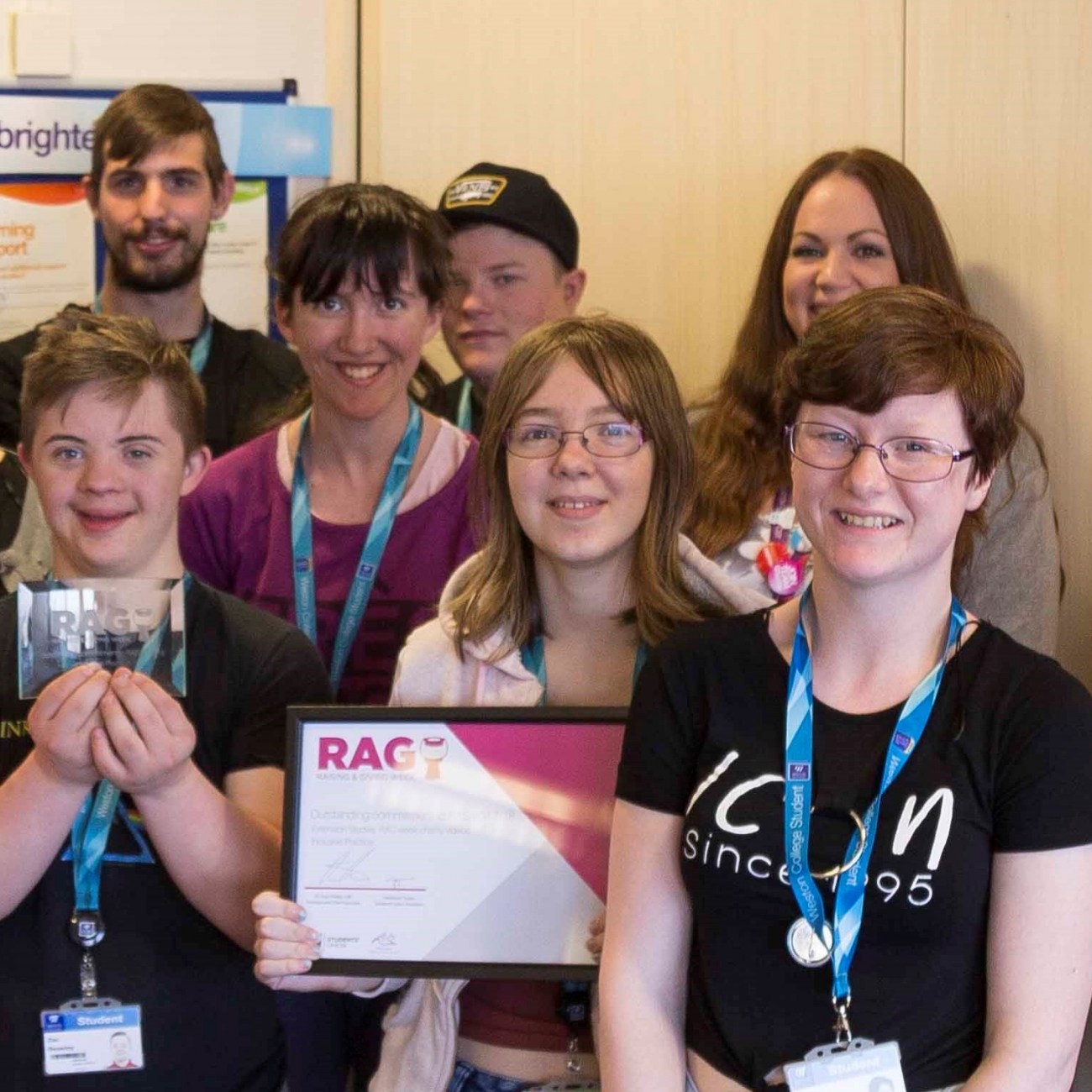
Weston College held a successful fundraising week in March, raising £3600 for local charity Weston Hospicecare.

Over the week students and staff from across the College took part in various activities, with the aim of raising money for the local charity.

The main event of the week was dress up day, in which staff and students all over the College got in the spirit, dressing up as superheroes, unicorns, octopuses and air hostesses for the day.

There were also a number of awards given out for those who contributed to the week’s success. The College’s Inclusive Practice Faculty won the overall award for fundraising, after students came up with inventive ways of raising money, including writing the first sentences of Harry Potter and the Philosopher’s Stone in coins.

Fundraising for weston hospicecare

Weston Hospicecare was thrilled with the money donated to them.

Rachel Mansfield, community fundraiser at Weston Hospicecare, said: “We are once again enormously grateful to the students of Weston College for the fabulous support offered during their RAG week celebrations.

“We’ve loved following the students’ exploits, and we’re thrilled by the incredible amount of money raised for Weston Hospicecare – it really will play a big part in enabling us to support people with life-limiting illnesses and their families across Weston-Super-Mare and beyond.

“We’d also like to say a special thank you to the students from Weston College’s Inclusive Practice Faculty, who won an award for an outstanding contribution to the charity week for a video they created on behalf of Weston Hospicecare – we enjoyed welcoming the students to the hospice when they were filming, and were really impressed by the super piece of work they put together.”

 

Weston College has employed Chris Lemin as its new Curriculum Lead for Cyber Security. Cyber security is the process of protecting networks, systems and  data from cyber-attacks. It is a hot topic, with the government estimating that large businesses face an average cost of £19,600 when presented with a cyber-security breach.

Chris brings a wealth of knowledge to the role, having worked for the Royal Air Force and as a commercial cyber-threat intelligence analyst for the past three years. As part of his most recent role, Chris dealt with a wide array of companies, assisting them in defending attacks from the internet.  

In February, Capgemini’s Digital Transformation Institute produced a study based on 1,200 senior executives, which highlighted that 68% of organisations are reporting a high demand for cyber skills. Chris is now writing the Level 4 cyber security apprenticeship standards, and is ensuring that these meet the needs of employers and give students the relevant training to meet these skills gaps. These apprenticeships will offer students the perfect mix of both education and exposure to the cyber security world, while gaining a formal qualification.  

As well as the new cyber security apprenticeship, the College is developing a cyber lab which will be based at the Winter Gardens.  This will allow the students the opportunity to practice a range of scenarios, from testing insecure networks to reconfiguring a network, giving them hands on experience.

Chris said: “Education is the key to cyber security, we are aiming to help organisations to meet the needs of their skills gap.”

For prospective university students and their parents, the costs and loans associated with university can be daunting and confusing. Many news articles obscure this further by presenting misleading information.

An article on FE News  recently analysed research from the bank ‘B’. The article refers to a series of statistics which creates the overall impression that students are in the dark with regard to student finance which is causing a series of issues.

  1. Students will not earn enough to repay their debt
  2. A quarter of students believe they will be bankrupt before they turn 30
  3. 38% of students don’t know how much they will owe
  4. 75% don’t know how much they will repay
  5. 52% don’t know when they will make repayments
  6. 80% don’t have a plan to manage their finances

The majority of these statistics and theories feed into the idea that all students going to university are going to be saddled with mountains of debt and that they will be faced with eye-watering and financially damaging repayments.

In reality the student finance system is far more supportive and the repayment mechanisms in place recover a proportion of the debt in a way which is financially sustainable for the graduate.

The idea that many students will not repay their debts might well be correct, but perhaps not to the extent that you would expect.

The Financial Times found that “About 70 percent of students who left university last year are expected never to finish repaying their loans, according to modelling carried out by the Institute for Fiscal Studies. Instead they will have to make repayments for 30 years before then having the unpaid loan written off".

The current system of student finance has a time limit on the repayments, this does not mean that 100% of the loan has to be repaid before the end of the term, but rather than any remaining debt on the account at that point is cleared in full.

At present, this term is set at 30 years from the April after the student graduates from university, therefore the misconception that students will be saddled with this debt for life is incorrect and it is unlikely that the majority of graduates will repay the loan in full.

The claim that a third of students believe that they will be bankrupt by the age of 30 stems from a deep seeded misunderstanding with how the student finance system works. To explore why this will, most likely, not be the case it is necessary to look at the amounts students will owe and how and when will graduates make their repayments.

In the present system the most a university can charge for tuition fees is £9,250 (a total of £27,750 over three years). In addition to this fee, students are able to apply for a means-tested maintenance loan, which if moving away from the parental home and not studying in London could add an extra £8,700 per year, or £26,100 over three years, to the total figure owed by students. The total amount which could be owed by a learner is £53,850 (based on 2018 figures with student moving away from home and not to London).

In addition to the total loan amount, there is interest from the day the first payment is made at a rate of the Retail Price Index (RPI) plus 3%. At present RPI is set at 3.1% and is a variable rate which is taken every March for the following year’s calculations. Therefore the amount that graduates owe is set to rise each month.

Graduating students do have the potential to owe over £50,000 in student loan debt when they graduate, this is undeniably a huge amount of money and if it were a regular loan would likely see the monthly repayments of up to £400 over a 25 year period.

This is where a comparison with a standard loan ends as student debt needs to be considered as something entirely different, this is what is often difficult for students and their parents/carers to understand. The mechanisms for repaying the student debt does not differ based on the amount borrowed, the terms of repayment are the same for all graduates.

Graduates will start to repay their loan as of the April after they graduate from university, or when they leave their course. Repayments will only begin once the graduate is earning above the threshold which is currently set at £25,000. Therefore any graduate who does not earn above this threshold will not make any repayments on their student debt.

Once a graduate is earning above the threshold they will make repayments on any amount over this threshold, which will be taken directly from their pay at a rate of 9% (for example if the graduate earns £26,000 they will repay 9% of £1,000 which would amount to repaying £90 in that tax year).

This mechanism for repayment is there to ensure that graduates are able to make affordable repayments on their student loan and graduates will not have to manage this debt as it is taken through their pay packets.

Therefore in comparison with a standard debt, which might see an annual repayment of £4,800 per year on a £50,000 loan, the student loan repayments are far more sustainable at 9% of earnings over £25,000 and the remaining debt at the end of the 30 year term is written off entirely.

In reality, the notion that almost a quarter of students believe that they will be declared bankrupt by the time they are 30 is likely a misconception based on misunderstanding the student finance system and the schedule of repayments.

Better representation and information in the media would act to provide a widespread education on student finance to alleviate students who feel anxious about repaying the money they are borrowing for higher education.

Many of the misconceptions about student finance are rooted in a lack of understanding of how student finance works and more positive actions by the media need to be taken to create some widespread change in the way that people regard student debt. It may be that extensive PR needs to take place or a ‘rebranding’ of what it is called to get away from the negative connotations with the word ‘debt’.

Students, and their parents/carers, need to be made aware of the positive aspects of the student finance system and they need to be completely aware of how much they will owe, how and when they will make the repayments and how long the term of the debt is. If this information is successfully communicated in the media then it may act to alleviate the anxiety felt by students so that they can understand that yes they have student debt, but that it will most likely not bankrupt them as their weekly/monthly repayments are always proportionate to their earnings and not to the amount they owe.

Hamish Gilpin, UCAS Lead, Weston College

CAREERS NOT COURSES

We know it’s not about the course you take, but the career you’ll start your journey towards. Your study programme is built from the ground up with your future in mind, focussing on employability and developing the skills you need to have a successful career within your chosen industry, making connections and gaining experiences through local and national employers we work with:


NHS logo
rolls royce logo
Armed Forces Covenant
Ministry of defence logo
Thatcher careers logo
Avon Fire and Rescue Service Logo
Occuteach Logo
GKN logo
YMCA logo
ashton gate logo
weston hospicecare logo
airbus logo
cadbury house logo
Lloyds bank logo
puxton park logo
the Bristol Port Company logo
howards motor group logo
mendip house nursery and pre school
taylor wimpy logo
congras cafe logo
yeo valley logo
career excellence hub logo

As a Weston College student, you will become part of one of our exciting new Career Excellence Hubs.

This means our courses aren't just courses... your study programme is built from the ground up with your future in mind, focussing on employability and developing the skills you need to have a successful career within your chosen industry...

LECTURERS WITH REAL INDUSTRY EXPERIENCES

COURSES ENDORSED BY EMPLOYERS

INDUSTRY STANDARD FACILITIES

INCREDIBLE WORK-BASED OPPORTUNITIES

AMAZING GUEST LECTURES

COURSES ENDORSED BY EMPLOYERS

Person wearing a welding helmet and gloves while performing welding on a metal surface.

"The college organised lots of amazing experiences for us with specialist guest lectures on sepsis, home care, nutrition and bee therapy"

Chloe

Health and Social Care, Level 2 & 3

Contact Us

Marketing Permissions

Once we have responded to your initial enquiry we would love to keep you informed of other, similar courses you may be interested in via email. You can unsubscribe at any time by clicking the link in the footer of our emails. For information about our privacy practices, please visit our policy page.

Email

By submitting this form you are consenting to Weston College recording and processing the personal information on this form, for any purposes of the college associated with the provision of advice and guidance to potential students on the range of courses available to them, college facilities and any other associated information. In accordance with the Data Protection Act 2018, the information will only be used for the above mentioned purposes.

You will need to complete a full enrolment form prior to starting your course.

CAPTCHA
This question is for testing whether or not you are a human visitor and to prevent automated spam submissions.

Apply or find out more


Marketing Permissions

We’d love to keep you informed about vacancies, courses, and updates we think you’ll find valuable. You can unsubscribe or opt out at any time.
Your personal information will be handled in accordance with our Privacy Policy.

Please let us know how you’d like to hear from us:

Email

By submitting this form you are consenting to Weston College recording and processing the personal information on this form, for any purposes of the college associated with the provision of advice and guidance to potential students on the range of courses available to them, college facilities and any other associated information. In accordance with the Data Protection Act 2018, the information will only be used for the above mentioned purposes.

You will need to complete a full enrolment form prior to starting your course.

CAPTCHA
This question is for testing whether or not you are a human visitor and to prevent automated spam submissions.

One Message, Different Voices

Take a look at this powerful film made by the staff of Weston College to show how important it is for everyone from different backgrounds to be included. The film shares heartfelt stories and interviews with a diverse group of staff, showing how accepting different identities and backgrounds can make a big difference. Its purpose is to encourage viewers to think about their own biases and work towards making our community more welcoming to all. We invite everyone, regardless of their background, to join us and be a part of our journey toward a more inclusive future.

Halo workplace logo

Our workplace champions the right of staff to embrace all Afro-hairstyles. We acknowledge that Afro-textured hair is an important part of our Black employees’ racial, ethnic, cultural, and religious identities, and requires specific styling for hair health and maintenance. We celebrate Afro-textured hair worn in all styles including, but not limited to, afros, locs, twists, braids, cornrows, fades, hair straightened through the application of heat or chemicals, weaves, wigs, headscarves, and wraps. In this workplace, we recognise and celebrate our colleagues’ identities. We are a community built on an ethos of equality and respect where hair texture and style have no bearing on an employee's ability to succeed.

Weston College held a successful fundraising week in March, raising £3600 for local charity Weston Hospicecare.

Over the week students and staff from across the College took part in various activities, with the aim of raising money for the local charity.

The main event of the week was dress up day, in which staff and students all over the College got in the spirit, dressing up as superheroes, unicorns, octopuses and air hostesses for the day.

There were also a number of awards given out for those who contributed to the week’s success. The College’s Inclusive Practice Faculty won the overall award for fundraising, after students came up with inventive ways of raising money, including writing the first sentences of Harry Potter and the Philosopher’s Stone in coins.

Fundraising for weston hospicecare

Weston Hospicecare was thrilled with the money donated to them.

Rachel Mansfield, community fundraiser at Weston Hospicecare, said: “We are once again enormously grateful to the students of Weston College for the fabulous support offered during their RAG week celebrations.

“We’ve loved following the students’ exploits, and we’re thrilled by the incredible amount of money raised for Weston Hospicecare – it really will play a big part in enabling us to support people with life-limiting illnesses and their families across Weston-Super-Mare and beyond.

“We’d also like to say a special thank you to the students from Weston College’s Inclusive Practice Faculty, who won an award for an outstanding contribution to the charity week for a video they created on behalf of Weston Hospicecare – we enjoyed welcoming the students to the hospice when they were filming, and were really impressed by the super piece of work they put together.”


Weston College has employed Chris Lemin as its new Curriculum Lead for Cyber Security. Cyber security is the process of protecting networks, systems and  data from cyber-attacks. It is a hot topic, with the government estimating that large businesses face an average cost of £19,600 when presented with a cyber-security breach.

Chris brings a wealth of knowledge to the role, having worked for the Royal Air Force and as a commercial cyber-threat intelligence analyst for the past three years. As part of his most recent role, Chris dealt with a wide array of companies, assisting them in defending attacks from the internet.  

In February, Capgemini’s Digital Transformation Institute produced a study based on 1,200 senior executives, which highlighted that 68% of organisations are reporting a high demand for cyber skills. Chris is now writing the Level 4 cyber security apprenticeship standards, and is ensuring that these meet the needs of employers and give students the relevant training to meet these skills gaps. These apprenticeships will offer students the perfect mix of both education and exposure to the cyber security world, while gaining a formal qualification.  

As well as the new cyber security apprenticeship, the College is developing a cyber lab which will be based at the Winter Gardens.  This will allow the students the opportunity to practice a range of scenarios, from testing insecure networks to reconfiguring a network, giving them hands on experience.

Chris said: “Education is the key to cyber security, we are aiming to help organisations to meet the needs of their skills gap.”

For prospective university students and their parents, the costs and loans associated with university can be daunting and confusing. Many news articles obscure this further by presenting misleading information.

An article on FE News  recently analysed research from the bank ‘B’. The article refers to a series of statistics which creates the overall impression that students are in the dark with regard to student finance which is causing a series of issues.

  1. Students will not earn enough to repay their debt
  2. A quarter of students believe they will be bankrupt before they turn 30
  3. 38% of students don’t know how much they will owe
  4. 75% don’t know how much they will repay
  5. 52% don’t know when they will make repayments
  6. 80% don’t have a plan to manage their finances

The majority of these statistics and theories feed into the idea that all students going to university are going to be saddled with mountains of debt and that they will be faced with eye-watering and financially damaging repayments.

In reality the student finance system is far more supportive and the repayment mechanisms in place recover a proportion of the debt in a way which is financially sustainable for the graduate.

The idea that many students will not repay their debts might well be correct, but perhaps not to the extent that you would expect.

The Financial Times found that “About 70 percent of students who left university last year are expected never to finish repaying their loans, according to modelling carried out by the Institute for Fiscal Studies. Instead they will have to make repayments for 30 years before then having the unpaid loan written off".

The current system of student finance has a time limit on the repayments, this does not mean that 100% of the loan has to be repaid before the end of the term, but rather than any remaining debt on the account at that point is cleared in full.

At present, this term is set at 30 years from the April after the student graduates from university, therefore the misconception that students will be saddled with this debt for life is incorrect and it is unlikely that the majority of graduates will repay the loan in full.

The claim that a third of students believe that they will be bankrupt by the age of 30 stems from a deep seeded misunderstanding with how the student finance system works. To explore why this will, most likely, not be the case it is necessary to look at the amounts students will owe and how and when will graduates make their repayments.

In the present system the most a university can charge for tuition fees is £9,250 (a total of £27,750 over three years). In addition to this fee, students are able to apply for a means-tested maintenance loan, which if moving away from the parental home and not studying in London could add an extra £8,700 per year, or £26,100 over three years, to the total figure owed by students. The total amount which could be owed by a learner is £53,850 (based on 2018 figures with student moving away from home and not to London).

In addition to the total loan amount, there is interest from the day the first payment is made at a rate of the Retail Price Index (RPI) plus 3%. At present RPI is set at 3.1% and is a variable rate which is taken every March for the following year’s calculations. Therefore the amount that graduates owe is set to rise each month.

Graduating students do have the potential to owe over £50,000 in student loan debt when they graduate, this is undeniably a huge amount of money and if it were a regular loan would likely see the monthly repayments of up to £400 over a 25 year period.

This is where a comparison with a standard loan ends as student debt needs to be considered as something entirely different, this is what is often difficult for students and their parents/carers to understand. The mechanisms for repaying the student debt does not differ based on the amount borrowed, the terms of repayment are the same for all graduates.

Graduates will start to repay their loan as of the April after they graduate from university, or when they leave their course. Repayments will only begin once the graduate is earning above the threshold which is currently set at £25,000. Therefore any graduate who does not earn above this threshold will not make any repayments on their student debt.

Once a graduate is earning above the threshold they will make repayments on any amount over this threshold, which will be taken directly from their pay at a rate of 9% (for example if the graduate earns £26,000 they will repay 9% of £1,000 which would amount to repaying £90 in that tax year).

This mechanism for repayment is there to ensure that graduates are able to make affordable repayments on their student loan and graduates will not have to manage this debt as it is taken through their pay packets.

Therefore in comparison with a standard debt, which might see an annual repayment of £4,800 per year on a £50,000 loan, the student loan repayments are far more sustainable at 9% of earnings over £25,000 and the remaining debt at the end of the 30 year term is written off entirely.

In reality, the notion that almost a quarter of students believe that they will be declared bankrupt by the time they are 30 is likely a misconception based on misunderstanding the student finance system and the schedule of repayments.

Better representation and information in the media would act to provide a widespread education on student finance to alleviate students who feel anxious about repaying the money they are borrowing for higher education.

Many of the misconceptions about student finance are rooted in a lack of understanding of how student finance works and more positive actions by the media need to be taken to create some widespread change in the way that people regard student debt. It may be that extensive PR needs to take place or a ‘rebranding’ of what it is called to get away from the negative connotations with the word ‘debt’.

Students, and their parents/carers, need to be made aware of the positive aspects of the student finance system and they need to be completely aware of how much they will owe, how and when they will make the repayments and how long the term of the debt is. If this information is successfully communicated in the media then it may act to alleviate the anxiety felt by students so that they can understand that yes they have student debt, but that it will most likely not bankrupt them as their weekly/monthly repayments are always proportionate to their earnings and not to the amount they owe.

Hamish Gilpin, UCAS Lead, Weston College