




COURSES FOR SCHOOL LEAVERS
Your Future Starts Here
With hundreds of exciting courses, this is where your journey begins. From day one, you'll be supported, inspired, and on track to a rewarding career.
See SubjectsJoin a Career Excellence Hub and gain real-world skills, experience, and confidence to reach your goals.
Whether you're finishing school, changing direction, or learning English with our ESOL courses – we’ve got you covered.
Get started today – pick a subject and apply online in just 5 minutes!

Find Your Future Path



















QUALIFICATIONS EXPLAINED
A Levels develop the knowledge, skills and study habits to excel at university, as well as the attributes recognised by employers.
Your academic studies will be complemented with enrichment opportunities such as trips, mentoring and work experience, providing the perfect springboard for your future career.
A Levels are assessed through exams at the end of two years of study. Most learners study three subjects - some choose four.
With an apprenticeship you’ll go straight into the workplace and be shown clear routes to progress straight into employment within a specific occupation. You can achieve nationally recognised qualifications, earn a wage, and gain skills that will see you get ahead. On average you will spend 20% of your learning time in the college and 80% within the workplace
Professional and technical qualifications are designed to provide you with the knowledge, skills and behaviours needed to gain employment within specific industries or occupations. They provide a balance between theory and practical skills development. They are suited to those who want to get hands-on experience within a particular vocational area. These programmes include work placements. Assessment is more varied and will include exams, coursework and practical work.
T Levels give you the chance to learn what a real career is like while you continue your studies. T Levels have been designed with leading businesses and employers to give you the knowledge and skills you need, including a minimum of 45 days on an industry placement – this means you will spend 80% of your learning time in College and 20% within the workplace.
LATEST NEWS
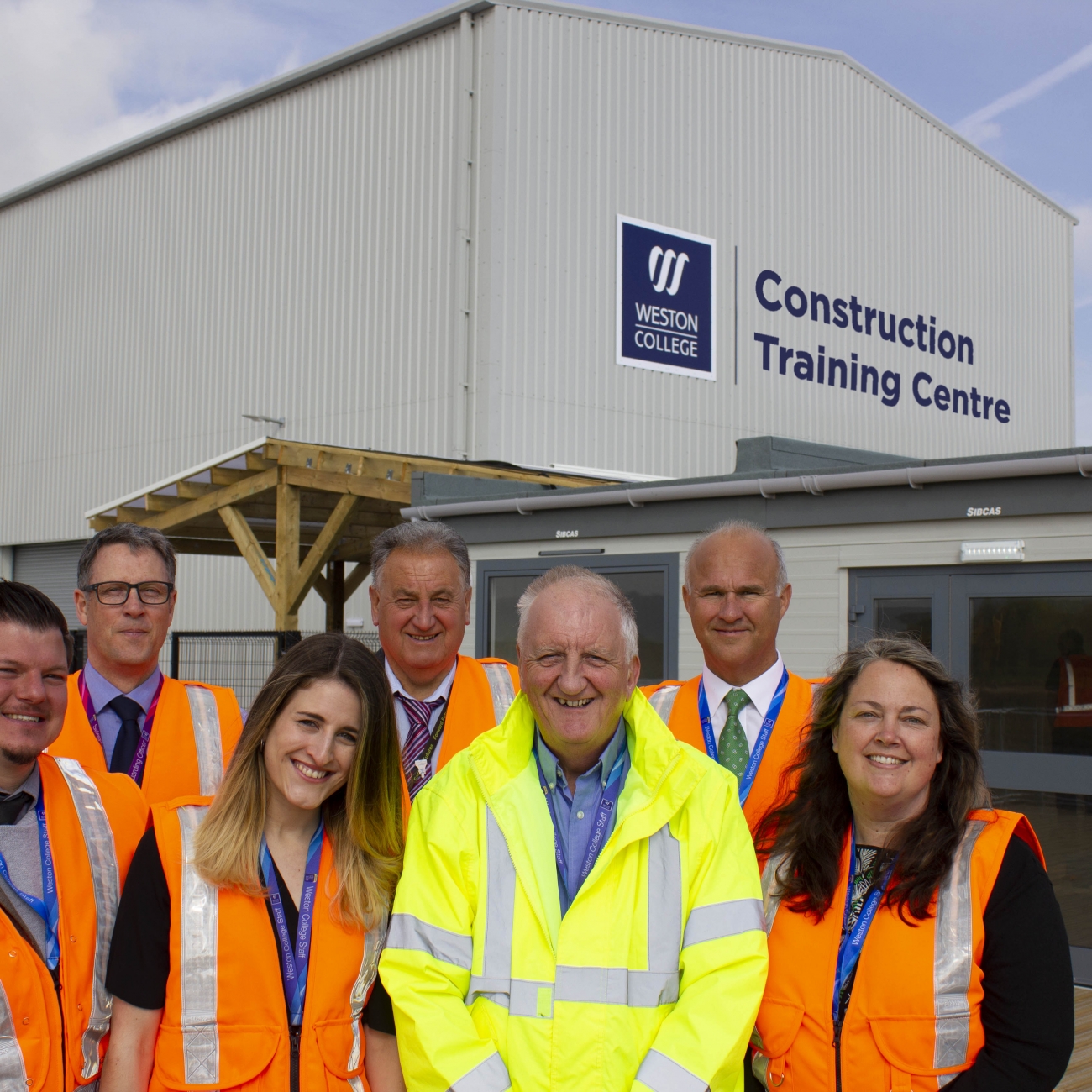
Weston College is set to play a lead role in tackling the construction skills shortage by opening a multi-million pound training centre.
The Weston College Construction Training Centre, completed by Midas Construction, opens in May and aims to offer training in seven key areas of training – plant, health and safety, scaffolding, highway and groundworks, warehousing (e.g. forklift training) and apprenticeships.
The state-of-the-art training centre has been created in response to the growing demand for a trained and skills construction workforce in the region. The industry-specific training it provides has been designed with employers’ needs in mind, and will be available on request, rather than fitting into the traditional academic year.
Dr Paul Phillips CBE, Principal and Chief Executive of the Weston College Group said: “The Construction Training Centre is a big step into commercial training and starts an exciting chapter for us.
“Over the last ten years, we’ve built strong relationships with employers to develop our apprenticeship provision. But we’ve recognised, more and more, the need to deliver training at the point of need – not only for school leavers during the academic year.
“The Construction Training Centre means employers can come to us at any time for short courses, top-up courses, and to up-skill staff who are taking on new roles.”
“This month we launched the new website – www.construction-training-centre.co.uk, which enables people to easily navigate between the seven key areas of training.
“It’s also designed to make it as quick and simple as possible to book and pay for the more basic training online. This includes non-practical, class based, one-day courses – for instance, Site Safety Plus, Health and Safety Awareness, and Driver CPC courses.” This training centre has been made possible through the efforts of Weston College in partnership with the West of England Local Enterprise Partnership and North Somerset Council.
The financial investment has been provided by the College match-funding a successful bid for £3.3m funding from the West of England Local Enterprise Partnership (LEP) through the Local Growth Fund, administered by the West of England Combined Authority.
Chair of the West of England LEP, Prof Steve West, said: “We’re really pleased to support the fantastic new Construction Training Centre at Weston College. This will help to equip our current and future construction workforce with the skills they need to drive forward the building of new homes, business premises and infrastructure as our region grows. It will also help them to secure better career prospects and make the most of the opportunities available right here in the West of England.”
West of England Mayor, Tim Bowles said: “Construction is a key contributor to our region’s growing economy. It’s clear that there are huge opportunities here and we need to continue to provide the right skills to sustain the industry. The West of England Combined Authority has committed to working with colleges, councils and businesses to help the construction industry fill the estimated 82,500 jobs that will be created by 2036. The new Construction Training Centre at Weston College is a great example how we are addressing that challenge. It will help prepare young people, apprentices and higher education students for successful careers in the construction sector.”
Derek Quinn, Executive director for Midas Construction, said: “We are delighted to have created a much-needed training centre which will benefit students and the wider construction industry for many years to come. Midas is passionate about supporting the training and development of our staff and the communities we work in so we are proud to help develop a highly skilled and highly-trained workforce for the future.”
Universities and colleges have set themselves challenging new targets to make further and faster progress on fair access to Higher Education. The new targets, agreed with the Office for Fair Access (OFFA), form part of the 183 access agreements approved today, and will help meet a Government ambition to double the rate of students from disadvantaged backgrounds entering Higher Education.
Professor Les Ebdon, Director of Fair Access to Higher Education, said:
“The access agreements I have approved today show that universities and colleges are setting stretching and ambitious targets to attract students from disadvantaged areas and then support them through their studies. Our work with universities and colleges has really borne fruit over the last decade. There are now greater rates of young people from disadvantaged backgrounds in Higher Education than ever before – but we know that talent is still being lost. Too many people who have the talent to excel are not given full opportunity to demonstrate their ability. Eroding the stubborn link between your background as a child and your life chances as an adult is a long-term project. But I am confident that this set of agreements can – and will – make a real and lasting difference for many years to come.
“I am enormously heartened to see the significant level of ambition in this set of access agreements. By making progress towards their own fair access challenges, universities and colleges will contribute to the Government’s national fair access goals. The Prime Minister and Minister for Universities have set a goal to double the rates of students from disadvantaged backgrounds by 2020, and these agreements send a clear message that universities are ready to do the hard work to make this target a reality.
“The work and ambition universities and colleges have committed to today will transform lives. The outreach work universities have planned will open the door to higher education for people who might otherwise have thought it was not for them. The people that universities work with now will go on to be the doctors, business leaders and engineers of the future.”
Each university and college with an access agreement sets their own targets depending on their own individual circumstances. These targets are then subject to OFFA’s approval. Among the targets universities and colleges have set for their 2016-17 access agreements are:
- All institutions have set a target on the make-up of their student body
- Around three quarters of institutions set a target to improve the rates of students continuing with their studies, while around 15 per cent set a specific target to help ensure that their students were well prepared for life after graduation.
- Many targets also focus on particular groups of disadvantaged students. For example:
- Over a fifth of institutions set targets designed to help care leavers access higher education and succeed in their studies
- Approximately forty per cent of institutions set targets around specific ethnic groups. This includes a range of targets to reduce attainment gaps between different groups of students
- Around a third of institutions set targets relating to disabled students.
In total, universities and colleges predict that they will invest £750.8 million in steady state through their 2016-17 access agreements. This consists of:
- £149.3 million on access activities. This includes long-term sustained outreach work, which identifies learners at an early stage, and helps to raise aspirations and attainment
- £148.0 million on work to support students through their studies – for example through tailored induction programmes for particular groups of students
- £54.6 million on progression activities, to ensure that students are well prepared for life after graduation
- £399.0 million on financial support, including bursaries, fee waivers and hardship funds.
Professor Ebdon continued:
“Our discussions and negotiations with universities and colleges have led to improved targets at 94 institutions. These new targets are evidence-led, strategic and deliverable, and I look forward to working with universities and colleges to make further, faster progress.”
For more information on the College's HE provision, click here.
Weston College's Access Agreement for 2016/17 has been approved by OFFA and outlines the measures the college will take to widen access to HE. Click here to download a PDF for more information.
More than 500 University Centre Weston (UCW) students celebrated achieving their degrees at three graduation ceremonies held in the town on Saturday (24th September).
Students in their mortarboards and gowns walked in processions to St John the Baptist Church for the ceremonies, where they enjoyed an inspiring speech from former triathlon world champion Chrissie Wellington and received scrolls to signify their academic achievements.
As well as being the largest ever group to graduate from UCW, the graduates of 2016 are also among the most successful, with close to a quarter of Honours students achieving First Class degrees – above the national average of 19%.
Staff from Bath Spa University and the University of the West of England, Bristol – UCW’s partner universities – were also in attendance to share the special day with the graduates.
Anthony Murray, UCW’s Vice Principal Higher Education, said: “It is always wonderful to celebrate the many successes of our students, and graduation at UCW keeps getting bigger and better.
“We are especially proud of our students in a year where UCW has achieved a fantastic outcome in the Higher Education Review, which saw independent assessors endorse our academic standards and praise how we teach and support our students.
“Almost all of the students who graduated last year are now either working or in further studies, and I’m sure that this year’s graduates also have bright futures ahead of them.”
Among the many UCW success stories this year are the 47% of graduates on the Bachelor’s degree in Applied Computing being awarded First Class Honours.
Course Coordinator Joe Abdulgani said: “These brilliant results reflect their talent and dedication and I’m really pleased everyone had such a memorable and enjoyable day.”
Every piece of coursework submitted and every exam taken by Rimante Zagreckaite, aged 21, on her Bachelor’s degree in Business Management with Sustainability was marked as a First, and she was surprised on Saturday by her father and brother flying in especially from Lithuania to see her graduate.
India Lawton, aged 21, who won the prestigious BDC New Designer of the Year Award at the New Designers Exhibition in London in July, graduated with a First after completing a Bachelor’s degree in Graphic Design.
India is moving to London this week having secured a graphic design role with Amazon.
She said: “After winning the award earlier in the summer and then finding out about the First and getting my job, this has been a great way to celebrate and say goodbye to UCW.”
The processions were fronted by a samba band and singer Marvin Muoneke.
The 20-year-old, who impressed judges on The Voice last year and has toured Britain with a musical over the summer, has progressed from UCW’s Foundation degree in Popular Music on to its new Bachelor’s degree in Professional Music Performance and Production.
John Byrne, aged 51, achieved a Bachelor’s degree in Counselling despite having suffered from throat cancer during the academic year.
Thankfully now in remission, John’s lecturers supported him while he was in hospital and he was able to keep up with his studies while receiving treatment.
He said: “I couldn’t have made a better decision than enrolling with UCW, and I think I speak for every graduate in saying a big thank you to our families and friends for supporting us and sharing this special day with us.”
WHICH LEVEL IS RIGHT FOR ME?